Digital Government Target State
The Digital Government Target State sets the direction for improved government digital services. The vision is to transform the public sector operating model, moving towards a customer-oriented approach.
Overview of the Target State
The Digital Government Target State outlines the creation of a centralised model. This model treats digital resources as a national asset and helps government connect better — within public sector and with partners outside government.
It defines the principles and actions needed to build the foundations for a long-term transformation.
This is as at . The Target State will continue to develop, with more detail added over time to support delivery and respond to new technologies and opportunities.
Government agencies must align to the Digital Government Target State.
A new operating model
Detailed description of diagram
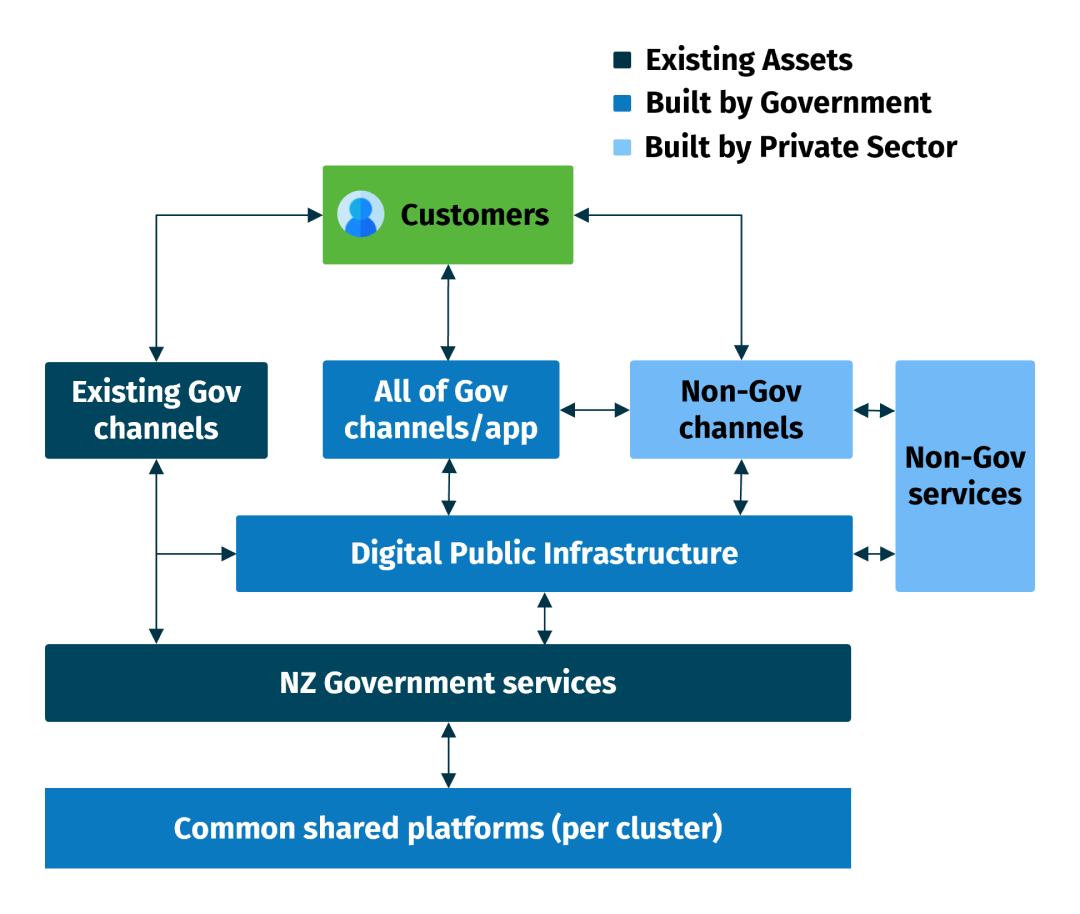
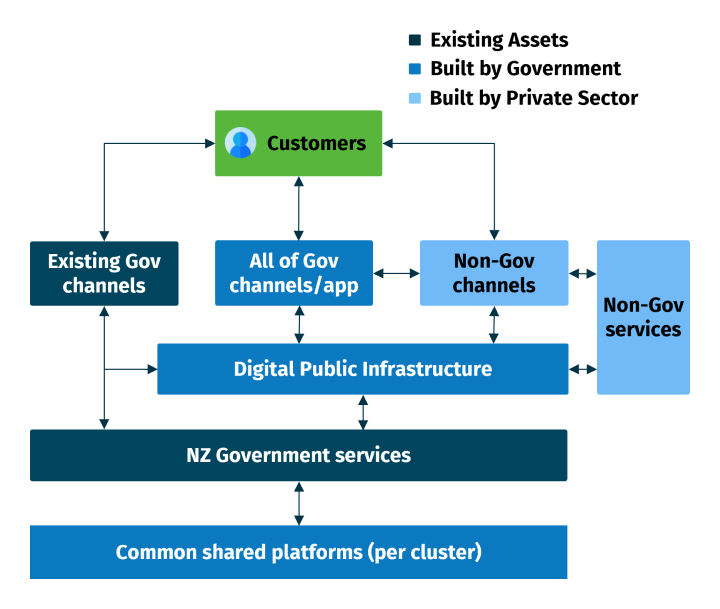
This diagram shows how customers access services through different channels, connected by a shared Digital Public Infrastructure (DPI).
At the top are Customers. Customers access services through 3 types of entry points:
- existing government channels
- All‑of‑Government channels (including the new Govt.nz app)
- non‑government channels.
New channels connect to a central Digital Public Infrastructure (DPI).
The DPI is shared infrastructure used by all agencies and does not depend on any single agency’s technology, data or business processes. Agencies provide their rules and data to the DPI, which delivers secure, authenticated services that follow centralised standards.
Below the DPI are NZ government services and common shared platforms.
These services and platforms both send data to and receive data from the DPI. Some highly specialised systems may remain outside the DPI, with agencies continuing to manage their own platforms and data.
The diagram includes a legend showing asset ownership:
- Existing assets: existing government channels and NZ government services
- Built by government: All‑of‑Government channels and government app, Digital Public Infrastructure, and common shared platforms
- Built by the private sector: non‑government channels and non‑government services
Download a detailed version of the Digital Government Target State:
Features of the Digital Government Target State
New ways to access connected services
People and organisations can interact with government through new digital channels (for example, the new Govt.nz app).
Users choose which channel they prefer, for the services they want to access.
Successful channels stay in place
Government agencies maintain what works for customers while looking for opportunities to use the new Digital Public Infrastructure (DPI) to enable new channels.
Digital resources are a national asset
The resources used to build government digital services are treated as a national asset — for example, secure digital platforms, data sharing, connectivity and standards. New AI-based technologies are also included.
Government systems are standardised
Back-office platforms are combined and processes are standardised, reducing costs.
Customer data is protected
People and organisations interacting with government services manage their credentials in a secure digital wallet, held on their device.
More channels, more flexibility
Government services and the DPI connect with external channels — including private business, iwi and other third parties. This allows external parties to offer customers more flexibility when interacting with government.
Agencies keep ownership
Agencies stay responsible for their data and core services. They share their rules, data and standards through the DPI, but keep overall ownership.
Core assumptions of the new model
The design relies on a set of core assumptions:
- Agencies will be grouped by common needs and services (clusters) to reduce duplication and share assets. Grouping will be phased in.
- Agencies will share information, rules and credentials with the Digital Public Infrastructure (DPI). This will be used to create services that protect privacy and use secure credentials.
- Services will be managed and delivered in the Govt.nz app, supported by the DPI. The DPI will store a transaction log for a period, but no other data.
- Physical channels will sit outside this digital architecture but follow the same approach as All-of-Government channels (for example, the new Govt.nz app).
- Key service information will remain held by agencies. The DPI data will be centrally managed, while customer credentials will be stored on users’ devices.
- Data sharing between agencies and the DPI layer will be enabled to trusted, authorised parties (for example, iwi Māori, community groups and businesses like banks and airlines).
Contact us
For further information, to ask questions or give feedback, email the Government Chief Digital Officer (GCDO).
Email: gcdo@gdda.govt.nz
Utility links and page information
Last updated