The future state of digital public services for New Zealanders
Sir Brian Roche's keynote at the Public Sector Network Innovation Showcase (May 2026). Sir Brian is the Public Service Commissioner and Head of Service. He also leads the Government Digital Delivery Agency and holds the system lead role of Government Chief Digital Officer (GCDO).
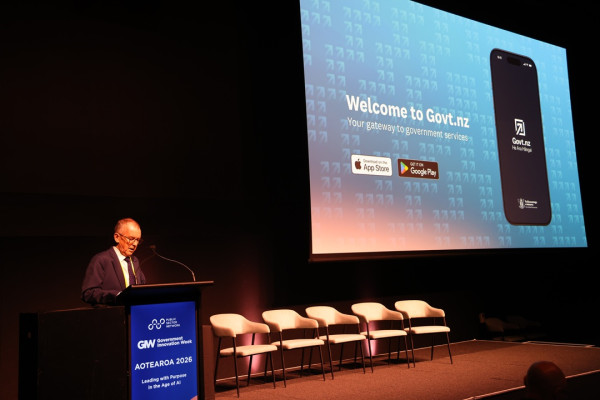
Kia ora koutou katoa, good morning.
First, thank you for this morning’s welcome and thank you to the Public Sector Network for pulling this week together.
Minister Goldsmith laid out the Government’s direction — and the push for a safer, more joined-up digital system, including the work underway on artificial intelligence (AI).
I haven’t been in the role very long. I’m still on a steep learning curve. But my job is clear — to move the public service from concept to delivery.
What I want to do this morning is talk about what the Minister’s overview looks like in real life.
What it looks like for a parent, a small business owner, a student, an older person — and what it looks like for the public servants in the room who have to make it real.
We’ve talked about ‘digital transformation’ for a long time. People know the tech is coming. What they want to know is:
- What will be different?
- What will feel easier?
- And how will we actually deliver it this time?
The problem: New Zealanders experience government as one – we still operate as many
Most people do not wake up thinking: ‘Today I’d like to deal with 5 agencies’. They just need to do a few basic things:
- confirm who they are
- get the right help
- pay what they owe
- and move on with their day.
But too often, we make people learn our organisational chart.
We ask them for the same details again and again.
We make them tell their story multiple times.
We make them jump between websites, phone numbers, offices and forms.
Inside government, we’ve built a lot of this complexity into how we work.
Over the years, we’ve accumulated systems, processes and structures that made sense at the time — but do not match how people live now.
So, when I say ‘goodbye to siloes’, I do not mean it as a slogan. I mean, we have to stop making organisational boundaries the customer experience.
The key for me is recognising that people’s time is valuable. Fragmentation is the enemy of efficiency.
The future state
On that note, let me paint 3 practical pictures of what joined-up really means.
These are not science fiction. We’re already well advanced with some of these — like when a couple has a baby. When a couple has a baby, they do not have to separately deal with:
- birth registration
- IRD numbers
- parental leave
- health enrolment
- childcare subsidies later on.
Parents do one secure update — online or with help in person.
Government then does the running around behind the scenes. Parents do not need to know which agency owns which piece.
They get clear prompts: here’s what you might need next, here’s how to do it, here’s where to get help.
That’s what ‘government as one’ feels like.
In a future joined-up model, the experience will be simpler for all Kiwis.
Picture 1: Turning 18 — stepping into work and study
Picture a young person turning 18. It’s a big moment — they might be finishing school, starting a job, applying for study, or figuring out what comes next.
Today, that journey can feel scattered. They might need to:
- apply for a student loan or allowance
- confirm their IRD details for work
- update their bank account information across different services
- look for part-time work
- understand what support they’re entitled to
- navigate accommodation options.
And too often, they’re left to join the dots themselves.
In a future joined-up model, that experience is much simpler.
When they turn 18, they get a clear, timely prompt — through the channel they prefer.
It says: ‘Here are the key things you might need to set up as you move into work or study.’
From there, they can:
- confirm or share their key details once, securely
- apply for support like a student loan or allowance in one place
- see what they’re eligible for, without having to hunt for it
- track their applications and next steps in one view.
If they choose to, they can share verified information — like identity or study status — across services without repeating themselves.
And if they get stuck, they can move easily between digital, phone, or face-to-face support — without starting again each time.
Behind the scenes, agencies are connected.
But from the young person’s perspective, it’s simple:
- clear guidance
- fewer forms
- no duplication
- and support that follows them as they move from school into work or study.
That’s what ‘joined-up’ looks like at a life milestone.
Picture 2: A small business — fewer forms, faster decisions
A small business owner wants to hire staff, stay compliant, and grow.
In the future state, we stop duplicating basic checks and forms across agencies.
A business can share verified information once, and re-use it — with proper consent and security.
If they need a licence or an approval, they can see:
- what stage it’s at
- what information is missing
- and how long it will likely take.
No chasing. No mystery.
Picture 3: Support that wraps around an elderly person
An older person’s needs do not arrive neatly inside one portfolio. Health, income support, housing, transport — it’s a mix.
In the future, the system is designed around life events and needs, not our internal lines.
People can get help through digital channels — but also through phone and face-to-face.
And the information-sharing behind the scenes means fewer repeat conversations and less paperwork.
Now — those are customer pictures.
Let me tell you what has to change inside government for those pictures to be real.
What changes inside the public service — the practical shifts
To get to that future, 4 practical things have to be true.
Shift 1: We move from ‘agency projects’ to shared building blocks
For a long time, we’ve built digital like this:
- Each agency funds its own project
- Builds its own platform
- Runs its own procurement.
And then we wonder why customers get a patchwork.
The future state is the opposite:
We invest in common building blocks that many agencies can use.
Things like:
- identity and credentials
- payments
- messaging and notifications
- appointment and case tracking
- information is shared automatically.
Not because centralisation is fashionable — but because it’s the only way we stop rebuilding the same capability over and over.
We’ll buy once and reuse where we can.
The real test will be whether we behave that way when a new project starts and the pressure is on.
Shift 2: Teams organise around outcomes — not just around functions
In the old model, a digital team might deliver a website.
Then hand it over. Then move on. In the future state, teams stay with the service.
They’re multi-disciplinary:
- policy
- service design
- delivery
- data
- privacy and security
- operational staff.
And they work to a clear outcome: faster decisions, fewer steps, less burden, higher trust.
That’s a big cultural shift. It means we stop treating delivery as the last chapter. Delivery is the work.
Shift 3: Data is treated as a strategic asset — with rules people can trust
Joined-up services depend on data. But let me be very clear — this is not about sharing everything with everyone. It’s the opposite.
It’s about putting people in more control of their own information, and using tools like digital identity to make that practical.
In a modern system, people can choose:
- what information they share
- who they share it with
- and when they share it.
They do not have to keep re‑entering the same details or handing over more than is needed.
Behind the scenes, there are clear rules so information is:
- used for a proper purpose
- accessed by the right people
- with the right controls.
And — crucially — the public can understand it.
People should be able to see, in plain terms, what’s happening with their information and why.
If we want New Zealanders to trust digital government, we have to earn it every day — by making it simple, transparent, and under their control.
Shift 4: We stop rewarding duplication — and start rewarding reuse
This one is blunt. As long as the system rewards ‘my agency delivered a thing’ over ‘New Zealand got a better service’, we’ll drift back into siloes.
So, part of delivery is changing incentives:
- funding that supports shared solutions
- procurement that favours reuse and interoperability
- governance that makes it easier to say yes to common platforms — and easier to retire old ones.
It’ll take discipline and shared foundations to turn the future-state into reality.
What this means practically for digital and AI
Let me say one thing about AI, because it’s part of the picture.
AI is not the strategy. AI is a tool — a powerful tool — but still a tool.
If we plug AI into broken processes, we just get broken processes faster.
The real win is when we pair AI with:
- simpler processes / new ways of doing things
- cleaner data
- shared platforms
- and clear rules.
Then you start to see the value:
- staff spend less time searching and re-entering information
- call centres resolve issues faster
- frontline workers get support with drafting, summarising, and triage — while still making the human decisions.
Minister Goldsmith covered the broader AI programme and the ‘how we do it safely’ settings.
My focus is delivery. Getting the foundations right — then AI becomes a multiplier, not a distraction.
So, what will you actually see change — in the next 12–18 months?
I’m not going to stand here and promise a perfect end-state overnight. We have to recognise we are dealing with deeply embedded ways of working. Changing processes and culture is a real challenge — and it’s not unique to the public service. Think about internet banking or online tax returns — people didn’t switch overnight. It took time to build confidence, change habits, and make those services simple and reliable.
This is hard work. It takes persistence. And it takes turning up every day to make the system a bit more joined-up than it was yesterday.
But you should expect to see 3 very practical things.
1. Fewer ‘one-off builds’, more reuse
You’ll see more services using shared patterns, shared components, and shared procurement approaches.
It won’t always be glamorous.
Sometimes the win will be as simple as not building yet another separate thing.
2. Clearer choices on what we stop doing
A future state requires stopping as well as starting. So, you’ll see more focus on retiring and consolidating legacy systems – not just adding new layers on top.
That’s where cost, risk, and resilience are won or lost.
3. Services designed around life stages and changes
This is an opportunity to redefine our core business — what we do and how we do it:
- Policy
- Regulation
- Delivery of AI and digital services.
You’ll see more services grouped and designed around common journeys — not the agency map.
And you’ll see a stronger expectation that we design with users — not just for users. We’ll test what we build with real people, and we fix what doesn’t work.
What I’m asking of leaders and practitioners in this room
Let me finish with something direct.
We do risk falling behind if we do not make these changes.
If you work in digital, data, design, service delivery, or procurement — you’re not on the sidelines of public service reform.
You’re right in the middle of it.
So here are 3 practical asks.
1. Work with the Government Digital Delivery Agency (GDDA) and other agencies to invest once and reuse
Even if it’s harder in the short term. Even if it means agreeing standards. Even if it means less freedom to customise.
Because every time we reuse what’s already there — instead of building something new — we free up money and talent for the next improvement.
2. Make it easy for people to do the right thing
If the safe, trusted path is slow and painful, people will go around it.
Design the guardrails so they work in practice — especially for frontline teams who need speed.
3. Keep it simple
If we can’t explain a service, a data use, or an AI decision in plain English, we’re not ready. Trust is built in plain language, not jargon.
Closing
To close, here’s my version of the future state in one line:
New Zealanders deal with government once — and government does the rest.
That’s the promise of joined-up delivery.
And it’s also what a modern public service should be:
- simpler
- more trustworthy
- more responsive
- and better value for money.
This work is not optional — and it can’t be done by one agency acting alone.
It’s system work. And it’s delivery work.
If we stay focused on what matters and do the hard work of delivery, we can build a public service that is simpler, stronger, and works better for every New Zealander.
Thank you for the part you play in making it real — and I’m looking forward to the conversations and the practical ideas that come out of this week.
Ngā mihi,
Sir Brian Roche KNZM
Te Tumu Whakarae mō Te Kawa Mataaho
Public Service Commissioner | Head of Service
Utility links and page information
Last updated